
English| EUR
Suggested for you
More currencies
Choose a language
Murano's glassblowing tradition has survived eight centuries not through secrecy, but through disciplined mastery of heat, timing, and material behavior. What looks like spontaneous artistry is actually a sequence of precise physical operations—each one dependent on temperature thresholds measured by eye and decades of muscle memory.
Quick answer
The glass blowing process in Murano begins with gathering molten glass from a furnace heated to 1400°C, then shaping it through controlled breath, rotation, and tool work before annealing in a cooling chamber. The entire sequence—from gathering to finished piece—takes between 15 minutes for simple forms and several hours for complex sculptures. Demonstrations at Fondamenta S. Giovanni dei Battuti, 12 run daily from 09:30 to 16:30, with a 5 EUR conservation fee.
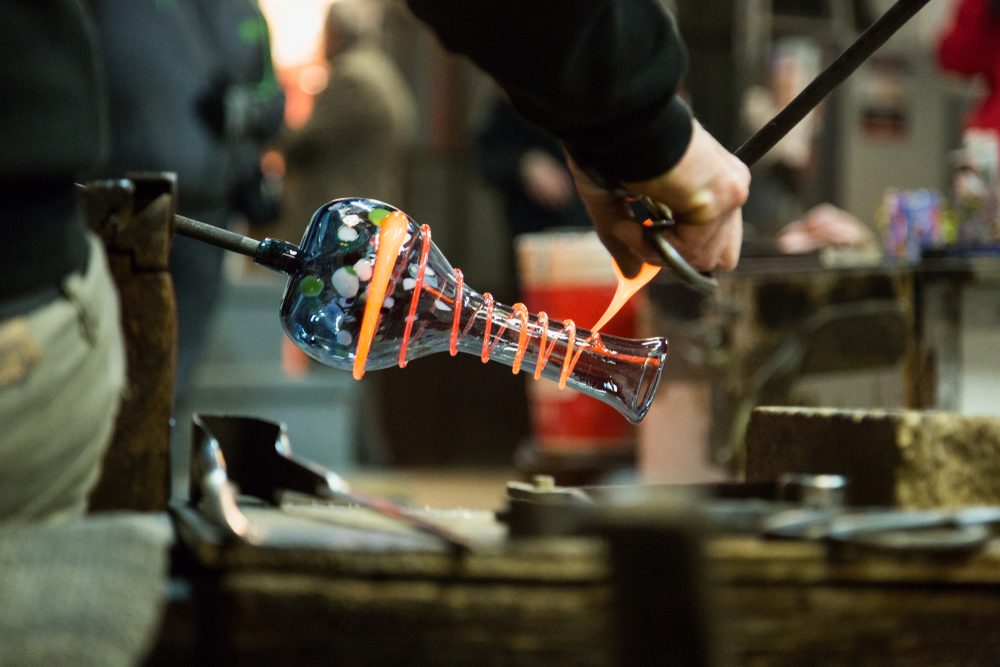
A single breath into the blowpipe creates a bubble inside a gather of molten glass weighing two kilograms, and that bubble must expand symmetrically or the piece collapses into expensive scrap. This is the split-second decision point where apprentices fail and maestri proceed without hesitation. The traditional Murano glassmaking technique unfolds in five stages. First, the maestro dips the blowpipe into the crucible and rotates it to collect a uniform gather of molten material at exactly 1100°C—too cool and it won't inflate, too hot and it sags off the pipe. Second, he rolls the gather on a steel marver to center its mass and pre-shape the form. Third comes the first inflation, a controlled breath that creates the parison, or initial bubble. Fourth, the gaffer uses wooden paddles, wet newspaper, and steel jacks to refine the shape while an assistant reheats the piece in the glory hole to maintain working temperature. Finally, the punty transfers the piece from blowpipe to solid rod so the opening can be finished, fire-polished, and detached with a sharp tap. What distinguishes Venetian glass is not the chemistry—silica, soda, lime—but the unbroken transmission of embodied technique. A maestro reads viscosity through the resistance of the pipe, judges temperature by the color of the glow, and times each reheat by counting breaths. The fornace at Fondamenta S. Giovanni dei Battuti has operated since the 1960s, its furnaces rebuilt every eight years but its core methods unchanged since the Republic restricted glassmakers to the island in 1291 to prevent fires and guard industrial secrets. Live demonstrations reveal what photographs cannot: the rhythm of collaboration between maestro and servente, the audible hiss of wet tools meeting 900-degree glass, the quarter-turn rotations that fight gravity's pull. The conservation fee supports both the demonstration space and the preservation of working furnaces, which consume three tons of natural gas monthly even when not in active production.
“A maestro reads viscosity through the resistance of the pipe, judges temperature by the color of the glow, and times each reheat by counting breaths.”
The Murano glass blowing process transforms raw silica sand and minerals into finished glass objects through controlled heating and shaping. From furnace to finished piece, the complete cycle spans approximately 24 hours including cooling phases.
Craftsmen combine silica sand, soda, lime, and metal oxides in precise ratios. The mixture is fed into the furnace at temperatures reaching 1400°C, where it melts into molten glass over several hours.
The maestro dips a hollow iron pipe into the furnace, rotating it to collect a uniform gather of molten glass on the end. Maintaining constant rotation prevents the glass from dripping off the pipe due to gravity.
Using a wet wooden paddle and metal tools, the glassblower shapes the gather while simultaneously blowing air through the pipe to create a hollow interior. Reheating in the glory hole (a secondary furnace opening) keeps the glass workable during this stage.
While the base form remains hot, the maestro applies colored glass canes, gold leaf, or murrine (glass rods with patterns) by rolling or fusing them onto the surface. Each addition requires precise temperature control to ensure proper adhesion without distorting the underlying shape.
Once the main body is formed, the piece is transferred from the blowpipe to a solid pontil rod attached to the base, allowing work on the opening. The transfer point will later be ground smooth during finishing.
Finished pieces enter a temperature-controlled annealing oven (lehr) where they cool gradually over 12-14 hours. Rapid cooling would create internal stress fractures that compromise structural integrity.
The production of Murano glass relies on specific chemical compositions and precise thermal management to ensure material integrity. Mastery over these scientific principles allows artisans to transform raw materials into durable glass objects.
The foundational mixture consists of silica sand (the glass former), soda (a flux to lower the melting point), and lime (a stabilizer to prevent water solubility). This chemical balance is essential for achieving the clarity and workability required for traditional glass blowing.
Raw glass batch is heated in furnaces reaching approximately 1,400 degrees Celsius to achieve a molten, viscous state. Maintaining this temperature is critical for ensuring the homogeneity of the glass mixture before shaping begins.
Glass expands when heated and contracts when cooled; improper control of these rates leads to structural stress and fractures. Artisans manage this by carefully monitoring the cooling rate of the material during and after the shaping phase.
Finished pieces are placed into an annealing lehr, an oven that gradually lowers the temperature of the glass over several hours. This controlled cooling process releases internal thermal stresses, preventing the glass from shattering due to uneven cooling.
When fusing different colors or components, masters must ensure each piece has a matching coefficient of thermal expansion. If the materials contract at different rates, the object will experience tension and crack or explode during the cooling process.
The glassmaker must operate within a specific viscosity range where the material is fluid enough to be shaped but stable enough to hold its form. Murano glass is noted for its ability to remain workable for a duration sufficient for complex artistic manipulation.
The glass blowing demonstration area is open daily to visitors throughout the week. Guests may observe the furnace operations during the following scheduled hours.
To observe the glass blowing process with minimal interference, the best arrival window is 09:30–15:30. Arriving within this timeframe helps avoid mid-afternoon crowds and ensures sufficient time to watch the artisans.
—
Visiting mid-week during the morning hours provides the quietest atmosphere for observing the glass masters. This allows for a clearer view of the technical steps without peak-hour distractions.
Mild temperatures (15°C–20°C)
These months offer a balance between comfortable outdoor weather and manageable visitor numbers. The moderate climate makes walking between Murano workshops more pleasant.
Warm temperatures (25°C–30°C)
Visitor numbers peak during these months due to high tourism volume. Planning your visit for the earliest possible arrival helps mitigate the impact of larger groups.
Verdict: The optimal time to visit is during the shoulder months of April or October, specifically arriving during weekday mornings at the 09:30 opening time.
The glass blowing demonstration site is located at Fondamenta S. Giovanni dei Battuti, 12, 30141 Murano, Venice, Italy. The most efficient approach is via the Venetian public water bus system, known as the Vaporetto.
ACTV Line 4.1 or 4.2 to Murano Faro station
From Murano Faro stop to Fondamenta S. Giovanni dei Battuti
Water taxi to Murano
Disembark at the Murano Faro stop and follow the canal side walkway to reach the address; arriving between 09:30 and 15:30 is recommended to avoid mid-afternoon crowds.
Everything you need to know about glass blowing process
The glass blowing process is an ancient technique involving the heating of silica sand in a furnace until it becomes molten. Skilled artisans then use a long metal pipe, known as a blowpipe, to shape the glass with tools and breath. This traditional method has been perfected in Murano over many centuries. Visitors can observe this intricate Venetian glass art first-hand to understand the heat and precision required.